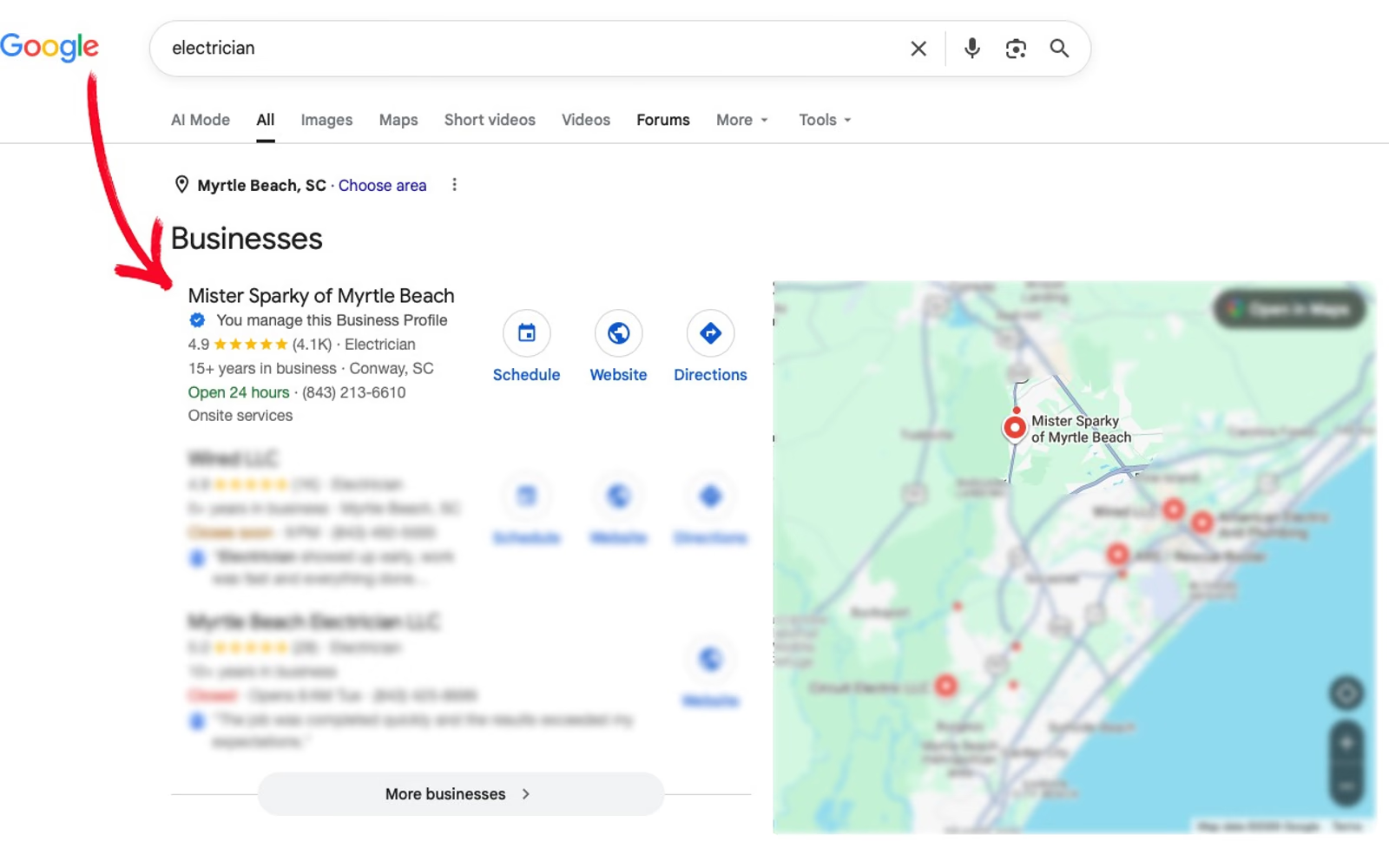
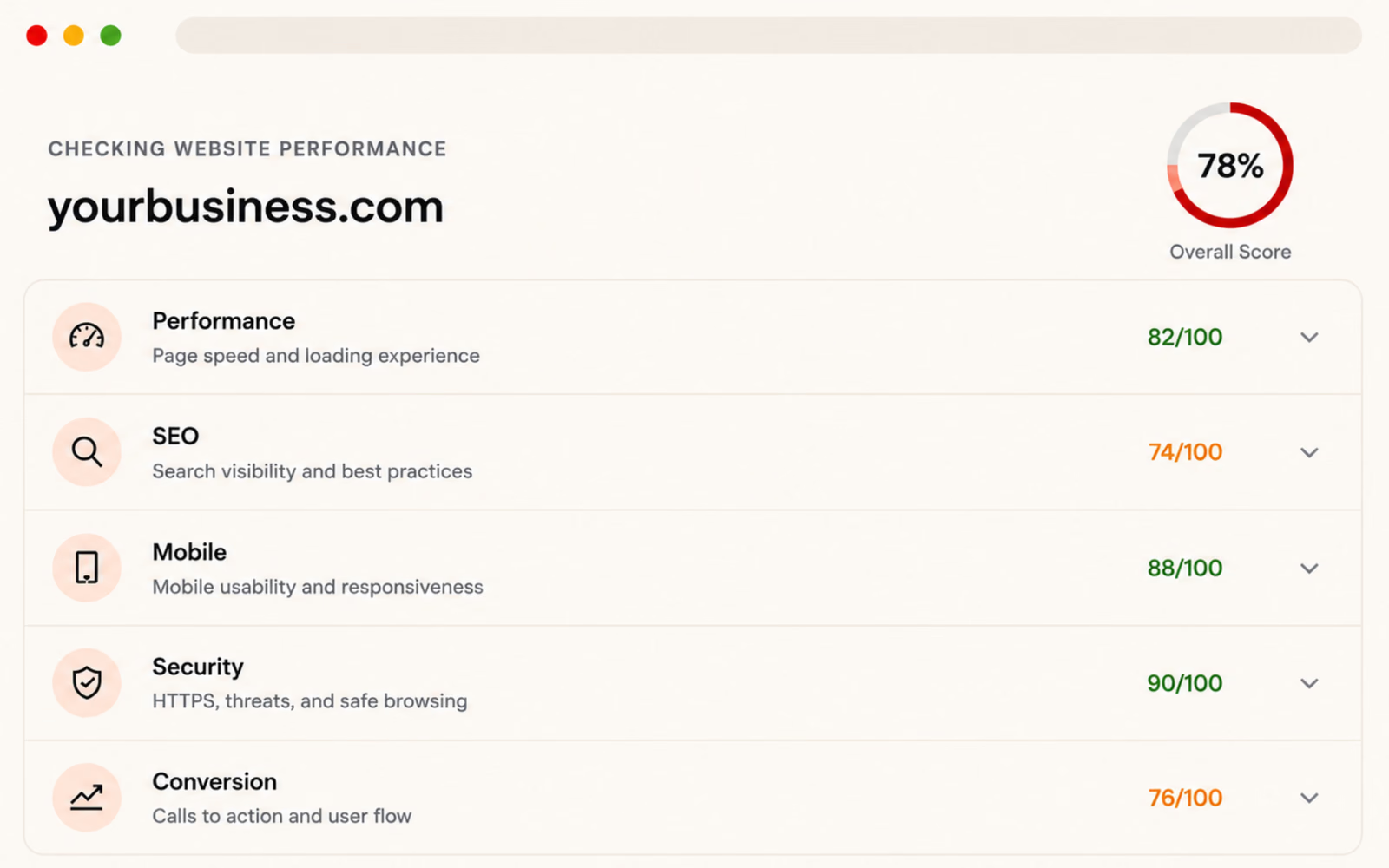
A few weeks ago I did my first ever live show. It was clunky. Took me forever to figure out how to even go live. I had maybe two viewers, and one of them was probably me.
So I did what any marketer would do. I asked ChatGPT, "What are the top 10 questions a home service company owner has about local search?" And then I answered every one of them. On camera. No script.
Here's the thing. Those 10 questions? I get asked them all the time. By plumbers. HVAC owners. Electricians. Tree guys. Roofers. Almost word for word.
So here they are, with the answers I'd give you if you sat across the table from me.
Want to watch instead of read? Here is the full replay of Fix My Marketing Live, Episode 1 on YouTube.
Quick Answers (If You're in a Hurry)
- Why am I not in the Map Pack? Google doesn't trust you as the authority yet. It's a mix of your Google Business Profile, website content, reviews, backlinks and domain age. Not one thing.
- How many reviews do I need? There's no magic number. Steady review frequency beats a one-time spike.
- SEO, Google Ads or LSA? All three, weighted by season and market. And "SEO" is really AI visibility now.
- Can I rank where I don't have an office? Yes, with a service area. A real, verified office in that city helps a lot.
- One website or one per city? It depends on your resources and goals. Either can work if it's structured right.
- GBP or website, which matters more? Both. Equally.
- Is AI changing local search? Yes. Fast. AI agents will soon be finding and booking contractors for people.
- How do I know if my SEO company is working? Ask for cost per lead (CPL) and return on investment (ROI). Rankings alone don't pay the bills.
Now the long version.
1. Why am I not showing up in the Google Map Pack for my main services?
Short answer: you haven't proven to Google that you're the authority for that service in that area.
Think about it. There might be 100 or 200 plumbers in your city. Google only shows three in the Map Pack (the "3-pack"). That's a brutal cut.
I always describe ranking like a pie chart. Every slice matters:
- Google Business Profile - filled out completely and correctly
- Website content - relevant, deep, well-structured pages for each service
- Reviews - on Google, but also Yelp, Facebook and other directories
- Backlinks - other trusted websites linking to yours
- Domain age and history - how long your site has been around
- Social signals - real activity and people talking about you
Here's what most owners miss. Hiring "an SEO company" isn't enough. Asking ChatGPT to spit out a few blog posts isn't enough. It's not about posting content. It's about knowing what content, where, and how it's put together.
If you're not in the 3-pack, you probably don't have a real system behind your marketing. It's a system. Not a blog.
2. How do I rank higher on Google Maps in the cities I actually want calls from?
Short answer: build trust, not keyword spam.
A lot of people still stuff their site with stuff like "plumber near me Dallas Fort Worth plumber Fort Worth." That doesn't work anymore. Google sees that as keyword stuffing and it can hurt you.
Start with your Google Business Profile. If you don't have one, create one. Then fill out everything:
- Your exact legal business name (Google checks it against your business entity)
- Address, phone number, hours
- The About section
- Services and products
- Photos. Lots of real photos.
- Regular Google posts
- FAQs
This isn't rocket science. But most people skip half of it.
And then do the part nobody likes: backlinks. Sponsor the local high school football team. Sponsor a community event. Get listed on .edu and .gov sites where it makes sense. If you're a plumber and a plumbing parts supplier links to your site, Google reads that as a relevant, trusted connection. That's a good backlink.
3. How many Google reviews do I really need to outrank my competitors?
Short answer: there's no set number. It's the wrong question.
I pulled up a live search for tree service on O'ahu during the show. The company sitting at #2 in the Map Pack had two reviews. Two. Meanwhile companies with 69, 106 and 200+ reviews were below them.
So no, reviews alone won't get you there. In a tougher market like Dallas, Houston or LA, two reviews won't cut it. But you can also have 1,000 reviews and get outranked by a company with a better-optimized site, better backlinks, or a domain that's 25 years old.
Here's my tip: go for frequency, not a spike.
Don't email all your friends, get 100 reviews in a month, then get five the next month. Google notices that pattern. What you want is a steady flow of reviews, every week, every month. Quantity matters. Consistency matters more.
4. Why is a competitor with fewer reviews and a worse website ranking above me?
Short answer: they're winning on something you can't see.
It could be:
- Domain age and history. Maybe they've had the same website since 1996. That history counts.
- Backlinks. They're getting shared on Reddit, Facebook groups, forums, "who do you recommend" threads. That's backlink juice. There's even a strategy to rank almost entirely on backlinks. It's expensive, but it works.
- Brand traffic. They're running billboards, display ads, geofencing or streaming TV (OTT). People search their name and click their site. Google sees all that traffic and figures they must be legit.
- Weak competition. In some areas, there just isn't much of a fight.
But here's the good news. They're not there because they're great. They're there because nobody's gone after them the right way yet.
And if you've been paying an agency for one, two, three years and you're still not there? You don't have the right system. SEO is not all the same.
5. Should I spend my money on SEO, Google Ads or Local Service Ads?
Short answer: all of it. Balanced by season and market.
Every channel is a different pillar bringing in revenue. My clients run Google Ads (PPC), Local Service Ads (LSA), SEO, plus stuff like Yelp, Angi, eLocal, and even postcards and direct mail.
"Daniel, I don't have that kind of money." Okay, let's do the math.
A $1 million home service company should be spending roughly $100,000 to $130,000 a year on marketing. That's about $8,000 to $11,000 a month. Split that across channels:
Google Ads (PPC) charges you per click. Whether that click turns into a customer or not, you're paying. Google has zero problem spending your money. Set $3,000, it'll spend $3,000. Set $100,000, it'll spend that too.
That's why PPC should flex with the seasons. If you're a three-truck HVAC company in July, you're already turning people away. Why are you spending big on clicks? In the slow months, that's when you push PPC harder.
Local Service Ads (LSA) charge per lead, not per click. If it's a spam call or a sales call, you can dispute it. The catch? You can set a $3,000 budget and only spend $500 because LSA depends on demand, your competition, your reviews and how well your profile is set up. If your LSA isn't optimized, it just won't serve.
SEO is where I'm going to push back on the question itself. It's not really "SEO" anymore. It's AI visibility. Google, ChatGPT, Perplexity, Gemini, Claude. SEO (search engine optimization), AEO (answer engine optimization) and GEO (generative engine optimization) all live under that umbrella now. That's what we tell our clients, and that's where your organic budget should go. (Here's how we break down our services.)
Whatever you spend, make your agency show you cost per lead (CPL) and ROI. More on that in question 10.
6. Can I rank in cities where I don't have a physical office?
Short answer: yes. But a real office makes it a lot easier.
We rank clients in multiple cities from one Google Business Profile all the time. If you're a service-area business, you tell Google which areas you serve (Dallas, Fort Worth, Denton, whatever) and Google can rank you there.
But it's hard. You have to know what you're doing.
The faster route is a real location. Not a PO box. Not a virtual office. An actual office with your name on the door. Google may ask you to verify it with video: record the signage, the truck, open the door, show your business entity, plus a lease, utility bill or phone bill. Try to cheat that and you risk getting suspended.
Is it worth it? We opened a new office for a client that was already established in Dallas. Within about a month, they were in the 3-pack in the new city. Sometimes $1,500 to $2,000 a month for an office you barely use pays for itself fast in new jobs.
7. Do I need separate location pages or separate websites for every city?
Short answer: it depends. Anybody who says there's one right answer is lying to you.
Old-school SEO says every major city gets its own website. That way the Dallas site only talks about Dallas and can be laser-focused.
Where things are going with AI, I lean toward one website with strong, dedicated city pages. Big franchisors do this. One site, hundreds of locations, each with its own location page.
The risk with one site is content cannibalization. There's only so much you can say about water heaters. If you have 300 locations all writing about water heater repair, Google can't tell which page to rank. You end up competing with yourself.
The fix is structure. Every location page has to be clearly built for that city, and each location should be treated like its own entity with its own marketing budget, all tied back to one site.
If you're a smaller company without franchisor-level resources, separate sites for each market (say Houston and Dallas, or Texas and Florida) can still make sense. Both approaches can work. It comes down to your goals and your resources. Not a cookie cutter.
8. How important is my Google Business Profile compared with my website?
Short answer: equally important. You can't pick one.
Think of it like a race car.
Your Google Business Profile is the body. The paint, the carbon fiber, the wheels, the wing. It's what people see, and the aerodynamics matter if you want to win.
Your website is the engine. Nobody sees it, but it's doing most of the work that gets you ranked.
Remember the company with two reviews sitting at #2? Their profile wasn't strong. Their engine was. You need both if you want to win the race.
9. How is AI changing local search? Do I need to show up in ChatGPT too?
Short answer: yes, and it's happening faster than most owners think.
Right now, most homeowners still use Google (and Gemini, which is Google's AI) to find a plumber. Or they say "Hey Siri, find me an AC company." ChatGPT isn't overtaking Google for local services yet.
But here's where it's going. And I'm talking within the next year or so, not ten.
You'll tell your AI assistant: "I need an affordable plumber next Wednesday. Find me three options." The AI calls five or six plumbers. It talks to their CSRs. It gets pricing and availability. Then it comes back: "Daniel, here are your top three. Here are their reviews and their fees. Which one?" You pick. The AI calls back and books it.
You didn't do any research. The AI did it all.
Google has already tested AI that calls local businesses to check pricing and availability for people. This isn't science fiction.
So what does that mean for you?
- Your website content has to be written so AI understands who you are, what you do and where. That part doesn't change. How you write it does.
- Your CSRs need to be ready to talk to AI agents. Seriously. Train them.
- Ranking on Google is not the same as showing up in ChatGPT. From what we're seeing, ChatGPT leans heavily on sources like Yelp for local businesses. If your Yelp presence is weak, you're probably invisible there.
Everybody has the same ingredients. Content, reviews, links, profiles. It's like two chocolate cakes with the same recipe. My daughter once made brownies with the exact recipe my wife uses. Not the same. How you put the ingredients together is what makes it great. Same with AI visibility. Who you hire matters.
10. How do I know if my SEO company is actually getting results?
Short answer: stop asking "where do I rank?" and start asking "what's my cost per lead and my ROI?"
Rank trackers are getting less reliable. Tools like SEMrush, Pro Rank Tracker and grid tools don't have a direct line to Google. When Google changes something, they lag. And you might rank in one part of Dallas but not another.
So here's what I'd ask instead.
Cost per lead (CPL). Total spend divided by leads.
You pay your SEO company $3,000 a month. You get 50 leads. That's $60 per lead. For organic, that's solid.
If your SEO leads are costing $200 to $300 each, that's expensive. For reference, we usually see Google Ads leads under $150 for our clients. I recently talked to someone paying $600 a lead on PPC. That makes me sick.
Return on investment (ROI). Revenue from those leads divided by what you spent.
50 leads. You close 30. Average ticket is $950. That's $28,500 in revenue from $3,000. That's about a 9.5 to 1 ROI.
My rough scale:
- Under 3:1 - you're breaking even or losing money
- 3:1 to 4:1 - okay
- 4:1 and up - really good
- 10:1 - great. Keep feeding it.
Those numbers can't lie. I can show you all kinds of pretty ranking reports. But if the CPL and ROI aren't there, I can't fluff it.
And take it one step further. A cheap lead that never books is worth nothing. Ask for your cost per booked job. That's the number that tells you whether the month actually worked.
If you are ranking and still not getting calls, check three things:
- Demand. Is anybody actually searching for this in your area? Check search volume.
- Your website. If there's demand and you're in the 3-pack but the phone isn't ringing, your site probably isn't converting.
- Tracking. Sometimes SEO is working but bad tracking means it never gets credit.
One exception: branding channels like billboards, TV, radio, geofencing and OTT. Those are hard to pin a CPL on. What they should do is lift everything else, because people remember you when they search later. Everything else (Google Ads, LSA, SEO, Yelp, Angi, eLocal) should be measured on CPL and ROI.
The Bottom Line
None of this is cookie cutter. Anybody who tells you it is, run.
But the owners who win all do the same thing. They stop chasing one tactic and start running a system. They measure what actually matters. And they hold their marketing people accountable. Us included.
A lot of agencies out there aren't doing good work, and business owners are paying a stupid amount of money for it. I'd rather you know the right questions to ask, whether you ever hire us or not.
Got a Question? Bring It Live.
I host Fix My Marketing Live every Monday at 10 AM Hawaii time / 3 PM Central on YouTube and Facebook. Bring your website, your Google profile, your ad numbers, whatever. I'll look at it live and tell you what I'd do.
Want to join on camera? Drop a comment on the Episode 1 replay saying "send me the link" and I'll get you in. Doesn't matter what you sell. Agencies too.
And if you'd rather have us just handle it, talk to Red Palm Studios.
Frequently Asked Questions
What is the Google Map Pack?
The Map Pack (or "3-pack") is the block of three local businesses Google shows with a map at the top of search results for local searches like "plumber near me." It sits under the paid ads and gets most of the clicks for local services.
How much should a home service company spend on marketing?
A common target is about 10-13% of revenue. For a $1 million company, that's roughly $100,000-$130,000 a year, or about $8,000-$11,000 a month, split across SEO/AI visibility, Google Ads and Local Service Ads.
What's the difference between Google Ads and Local Service Ads?
Google Ads (PPC) charges per click, whether or not the click becomes a customer. Local Service Ads (LSA) charge per lead, and you can dispute leads that aren't real customers, like spam or sales calls.
What is AI visibility?
AI visibility is how often and how accurately your business shows up in AI-driven search: Google's AI results, ChatGPT, Gemini, Perplexity and Claude. It includes traditional SEO plus AEO (answer engine optimization) and GEO (generative engine optimization).
What is a good ROI for home service marketing?
Anything above 4:1 is really good. 3:1 to 4:1 is okay. Under 3:1, you're roughly breaking even or losing money once you factor in costs.